Add a Feature

Start the Day Your Way: Turning Playlists into Alarms on YouTube Music

ROLE

UX Designer

EXPERTISE

UX/UI Design

YEAR

2024

Overview

This project explores enhancing YouTube Music by introducing features that make playlists more adaptive to users' lifestyles. Through research and ideation, I focused on designing tools that support routine-building and playlist management, making music more intuitive, timely, and personal.

Background

YouTube Music is a leading streaming platform that allows users to listen to music, watch videos, and discover new content.

Problem

While it offers a rich selection of playlists and recommendations, its integration into users’ daily routines remains limited. Many users rely on music not only for entertainment but also to motivate their mornings and improve their daily habits.

Research Goal

The goal of this research is to identify opportunities to improve playlist sorting and organization by analyzing common patterns, strengths, and weaknesses in leading music streaming platforms.

Objectives

  1. Identify common patterns and usability issues.

  2. Analyze how top music platforms improve users experience with playlists.

  3. Evaluate strengths and weaknesses of current solutions.

  4. Find opportunities to improve sorting and organization.

User Interview

I conducted live task-based user interviews, observing how participants created and managed playlists across Spotify and YouTube Music to capture real-time pain points and preferences.

  • All participants preferred Spotify for its convenience (rated 5/5).

  • YouTube Music was overwhelming at first glance due to too many buttons.

  • Participants wanted a drag-and-drop feature for easier song arrangement.

  • Users found it inconvenient to add songs on YouTube Music because it required changing pages.

  • Playlists are critical for quick access to favorite songs and for matching users' moods/vibes.

"I do think the design is straightforward when I was creating a playlist, but at the same time, it kinda looked overwhelming to me."

— John, Interviewee

"I play different playlist based on my mood or what I want to feel."

— Carmela, Interviewee

POV

A time-conscious user needs a way to start their day with the right music automatically because it helps set the tone without needing to remember or interact with the app.

HMW

How might we help users integrate music into their daily rituals without manual effort?

"I do think the design is straightforward when I was creating a playlist, but at the same time, it kinda looked overwhelming to me."

— John, Interviewee

"I play different playlist based on my mood or what I want to feel."

— Carmela, Interviewee

POV

A time-conscious user needs a way to start their day with the right music automatically because it helps set the tone without needing to remember or interact with the app.

HMW

How might we help users integrate music into their daily rituals without manual effort?

"I do think the design is straightforward when I was creating a playlist, but at the same time, it kinda looked overwhelming to me."

— John, Interviewee

"I play different playlist based on my mood or what I want to feel."

— Carmela, Interviewee

POV

A time-conscious user needs a way to start their day with the right music automatically because it helps set the tone without needing to remember or interact with the app.

HMW

How might we help users integrate music into their daily rituals without manual effort?

Affinity Map

Users preferred Spotify for its clean interface and smooth playlist features like drag-and-drop and in-page editing, making music organization fast and effortless.

Participants found YouTube Music overwhelming and inconvenient, with too many buttons and extra steps that made managing playlists feel frustrating.

User Persona

Sera, 25

Sera, 25

Sera, 25

Teacher Assistant

Teacher Assistant

Teacher Assistant

“I just want my music to match my day without having to think about it .”

“I just want my music to match my day without having to think about it .”

“I just want my music to match my day without having to think about it .”

BIO

BIO

BIO

Sera is a teaching assistant in an infant-toddler classroom. Outside of work, she enjoys staying active and often listens to upbeat music during workouts and in the morning to energize her day.

Sera is a teaching assistant in an infant-toddler classroom. Outside of work, she enjoys staying active and often listens to upbeat music during workouts and in the morning to energize her day.

Sera is a teaching assistant in an infant-toddler classroom. Outside of work, she enjoys staying active and often listens to upbeat music during workouts and in the morning to energize her day.

GOALS

GOALS

GOALS

Have a seamless way to automate and organize her music to match her daily routines and keep her motivated throughout the day.

Have a seamless way to automate and organize her music to match her daily routines and keep her motivated throughout the day.

Have a seamless way to automate and organize her music to match her daily routines and keep her motivated throughout the day.

NEEDS

NEEDS

  • A way to automate music playback based on time of day or routine

  • Tools to quickly organize and edit playlists

  • Music that matches her energy and mood without extra effort

  • A way to automate music playback based on time of day or routine

  • Tools to quickly organize and edit playlists

  • Music that matches her energy and mood without extra effort

  • A way to automate music playback based on time of day or routine

  • Tools to quickly organize and edit playlists

  • Music that matches her energy and mood without extra effort

FRUSTRATIONS

FRUSTRATIONS

FRUSTRATIONS

  • Manually setting up music every morning feels repetitive

  • Difficult to sort or move songs between playlists quickly

  • Lack of automation in music apps makes routine-building harder

  • Manually setting up music every morning feels repetitive

  • Difficult to sort or move songs between playlists quickly

  • Lack of automation in music apps makes routine-building harder

  • Manually setting up music every morning feels repetitive

  • Difficult to sort or move songs between playlists quickly

  • Lack of automation in music apps makes routine-building harder

PERSONALITY

PERSONALITY

PERSONALITY

Organized

Organized

Organized

Energetic

Energetic

Energetic

Independent

Independent

Independent

Derek, 21

Derek, 21

Sales Associate/Student

Sales Associate/

Student

Sales Associate/

Student

“I just need music that helps me focus and wind down — without the hassle.”

“I just need music that helps me focus and wind down — without the hassle.”

“I just need music that helps me focus and wind down — without the hassle.”

BIO

BIO

BIO

Derek is a part-time worker and full-time student who unwinds from his busy days by listening to calming music, which helps him focus on assignments and fall asleep more easily.

Derek is a part-time worker and full-time student who unwinds from his busy days by listening to calming music, which helps him focus on assignments and fall asleep more easily.

Derek is a part-time worker and full-time student who unwinds from his busy days by listening to calming music, which helps him focus on assignments and fall asleep more easily.

GOALS

GOALS

GOALS

Derek wants an effortless way to use music to stay focused during study and relax before sleep.

Derek wants an effortless way to use music to stay focused during study and relax before sleep.

Derek wants an effortless way to use music to stay focused during study and relax before sleep.

NEEDS

NEEDS

NEEDS

  • A way to automatically play relaxing music at bedtime

  • Easy access to focus-friendly playlists while studying

  • Minimal distractions or steps when switching between moods

  • A way to automatically play relaxing music at bedtime

  • Easy access to focus-friendly playlists while studying

  • Minimal distractions or steps when switching between moods

  • A way to automatically play relaxing music at bedtime

  • Easy access to focus-friendly playlists while studying

  • Minimal distractions or steps when switching between moods

FRUSTRATIONS

FRUSTRATIONS

FRUSTRATIONS

  • Takes too long to find the right playlist for studying or sleeping

  • Switching between moods (focus vs. relax) isn’t seamless in current music apps

  • Takes too long to find the right playlist for studying or sleeping

  • Switching between moods (focus vs. relax) isn’t seamless in current music apps

  • Takes too long to find the right playlist for studying or sleeping

  • Switching between moods (focus vs. relax) isn’t seamless in current music apps

PERSONALITY

PERSONALITY

PERSONALITY

Hardworking

Hardworking

Hardworking

Introspective

Introspective

Introspective

Minimalist

Minimalist

Minimalist

User Flows

Task #1: Move multiple songs from a playlist to a different playlist

The new flow allows users to tap and select multiple songs from any playlist, then simply drag them into a new or existing playlist. A confirmation toast gives feedback, and users can undo the action if needed.

Task #2: Set a timer/reminder for a playlist to play in the morning

"I designed a feature that allows users to schedule a playlist to start playing at a specific time — just like setting an alarm. From the playlist menu, users can tap ‘Set Timer’, choose a time, and select whether it repeats on specific days."

Wireframes

Wireframes

Inspired by common file management behaviors, I sketched out a low-fidelity interaction where users could tap to select multiple songs, then drag and drop them into another playlist. The goal was to make organizing music as easy and intuitive as moving files on a desktop.

Homepage
Homepage
Playlist #1:
Select songs
Playlist #1:
Select songs
Playlist #1:
Drag Selected songs
Playlist #1:
Drag Selected
songs
Playlist #2
Playlist #2

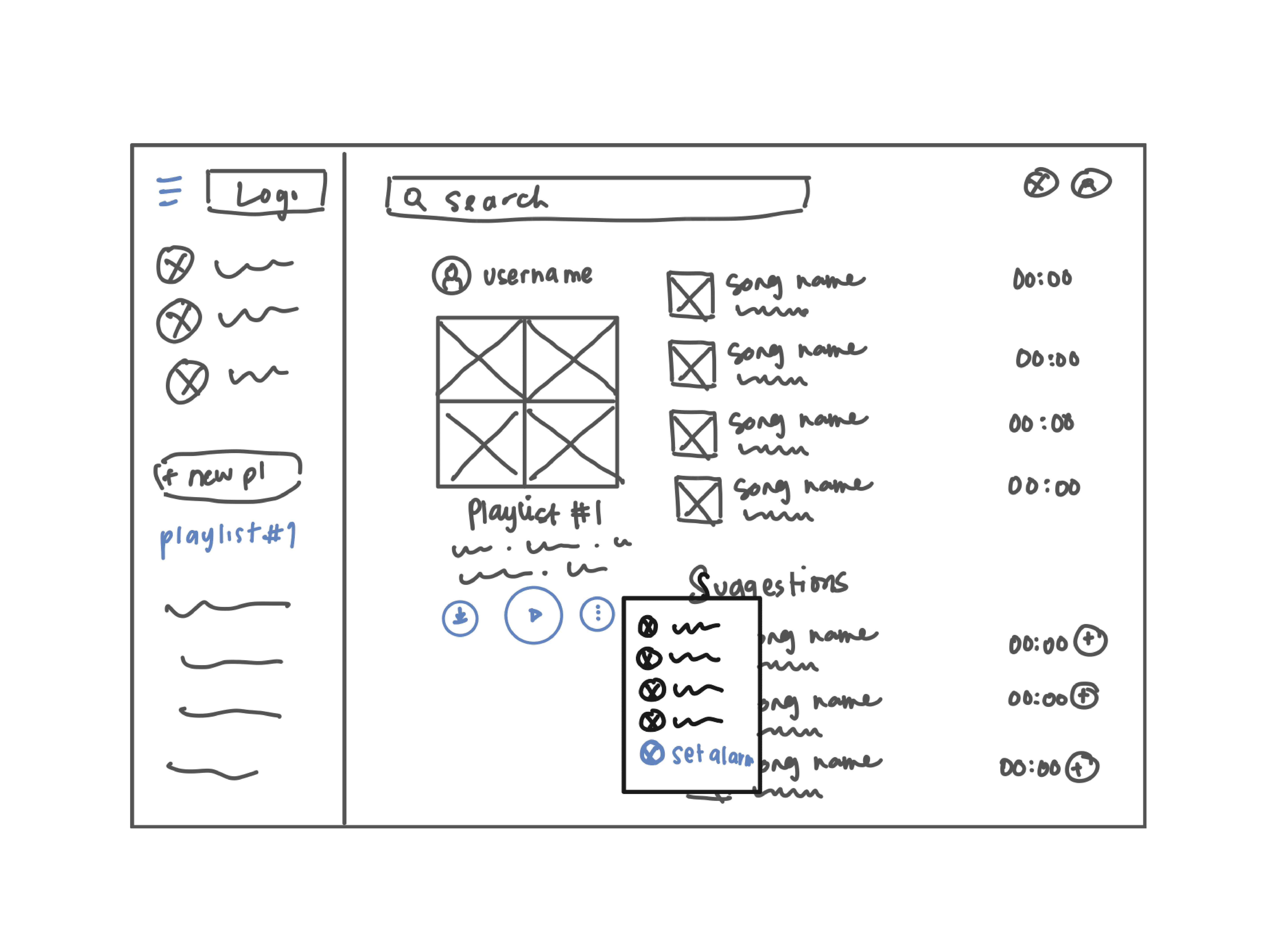
I sketched out a feature that allows users to schedule a playlist to play automatically at a set time, much like an alarm — but with their own music, not just a default ringtone

Homepage
Homepage
Playlist #1
Playlist #1
Options > Set Alarm
Options > Set Alarm
Input time and Set
Input time and Set

UI Design

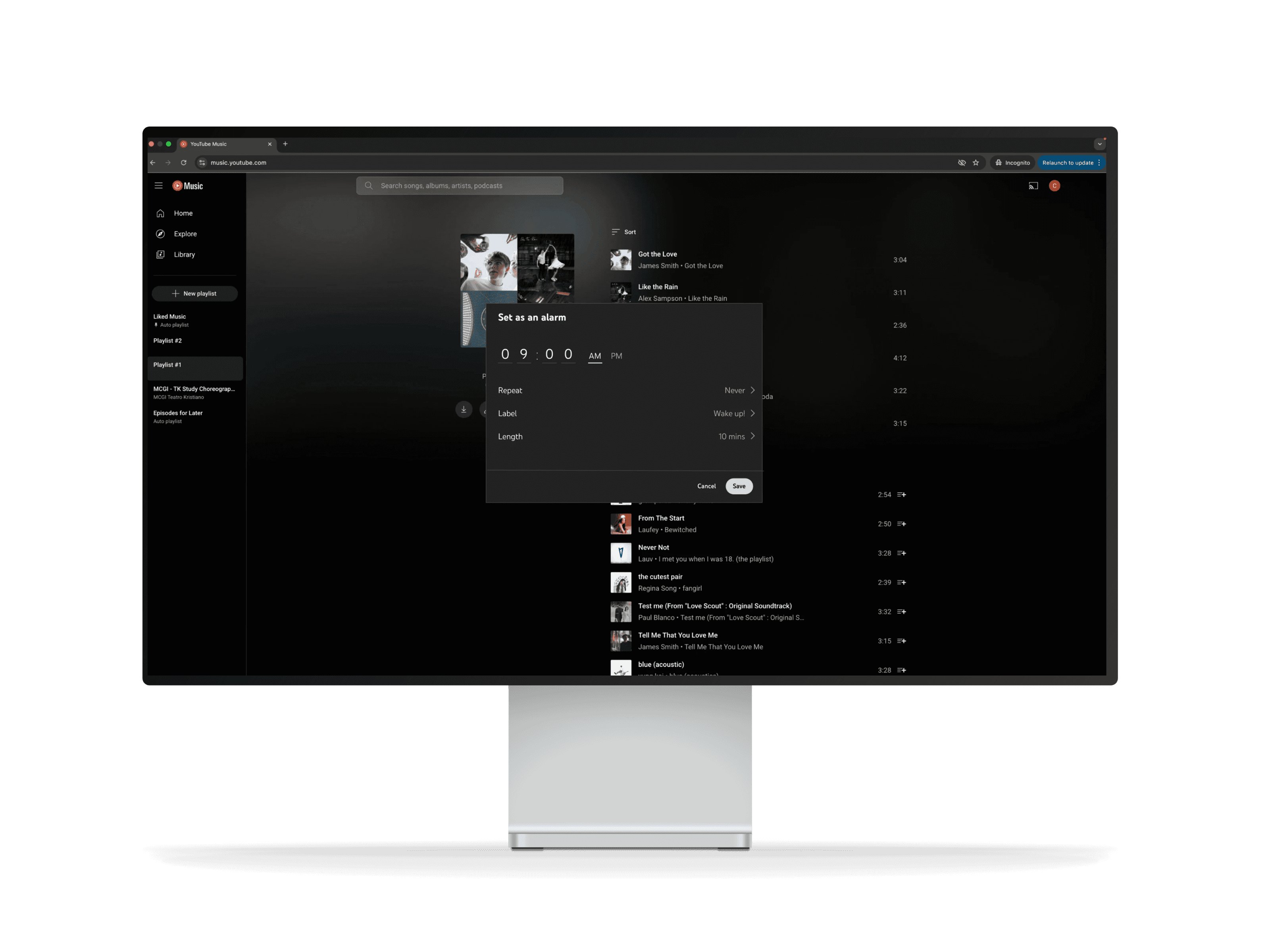
  • Set as an alarm

    Option to set a playlist to play at any time of the day.

  • Change default settings

    Easily set your playlist alarm time, days, and label.

  • Alarm confirmation

    Confirmation banner appears after setting the alarm. Undo or edit, if needed.

  • Set as an alarm

    Option to set a playlist to play at any time of the day.

  • Change default settings

    Easily set your playlist alarm time, days, and label.

  • Alarm confirmation

    Confirmation banner appears after setting the alarm. Undo or edit, if needed.

Usability Testing

We tested a prototype feature that allows users to set a YouTube Music playlist as their morning alarm. The goal was to understand how intuitive this new functionality is, and identify points of confusion or friction.

Users frequently overlooked the "Set as Alarm" option because it was not visually prominent in the interface. Given that setting a playlist as an alarm is a key feature likely to be used regularly, it needs to be surfaced more clearly in the user flow. Improving its visibility not only supports ease of access but also reinforces the feature’s value and discoverability

Iteration

To address visibility issues, we moved the "Set as Alarm" option higher in the options list, making it easier for users to find and access quickly. This adjustment prioritizes a key action that many users are likely to use frequently, reducing friction and improving overall task efficiency.

Wrap up

This project emphasized the value of designing for everyday usability—especially in routines like waking up. By identifying friction in the alarm playlist customization flow and iterating based on real user feedback, we were able to streamline the experience and surface key features more clearly. Through thoughtful testing, visual hierarchy improvements, and simplified flows, we transformed a confusing setup into a user-friendly, personalized wake-up solution. This case study reinforces how even small UI decisions—like option placement or clearer labels—can significantly enhance user confidence and satisfaction.